From Old Sarum to the Water Meadows
The cathedral's origins lie at Old Sarum, approximately two miles north of the present city, where the earlier church stood. Relations between the clergy and the military garrison there had deteriorated, and Bishop Herbert Poore sought permission to relocate in 1197. The move was eventually carried out by his brother, Bishop Richard Poore, who laid the foundation stones on 28 April 1220 on the site that would become the centre of modern Salisbury. The decision to relocate effectively created the city of Salisbury as it exists today, with the cathedral and its close at the heart of the medieval street plan.
A Unified Design in Just 38 Years
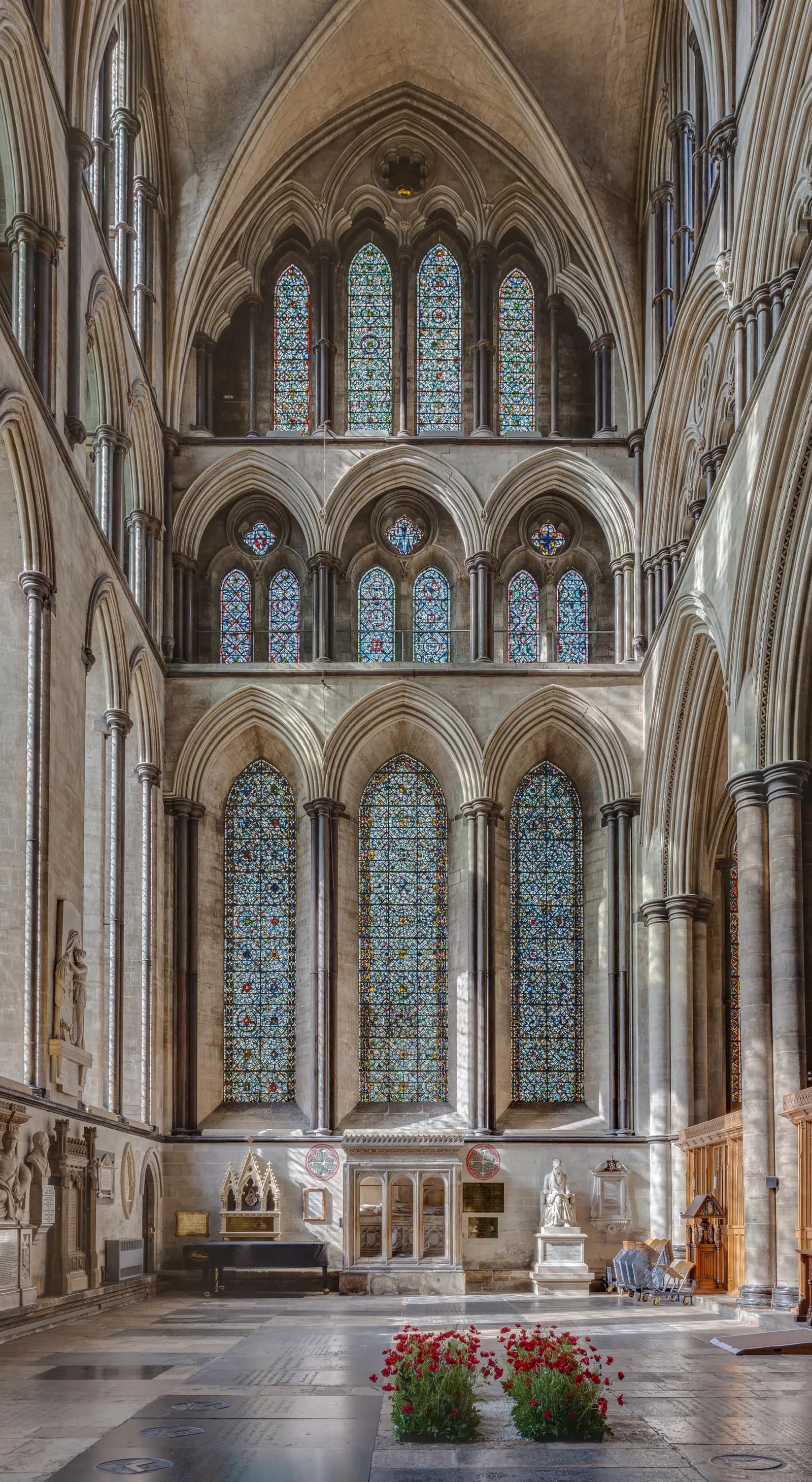
The nave, transepts, and choir were completed by 1258, giving the cathedral a coherence rare in medieval English architecture. Because the main structure was built in a single campaign, the building exhibits a consistent Early English Gothic style, characterised by tall lancet windows without tracery. The cloisters were added in 1240 and the octagonal chapter house in 1263. The tower and spire, however, were not finished until 1330, extending the overall project well beyond the initial 38-year phase.
The Tallest Spire in Britain
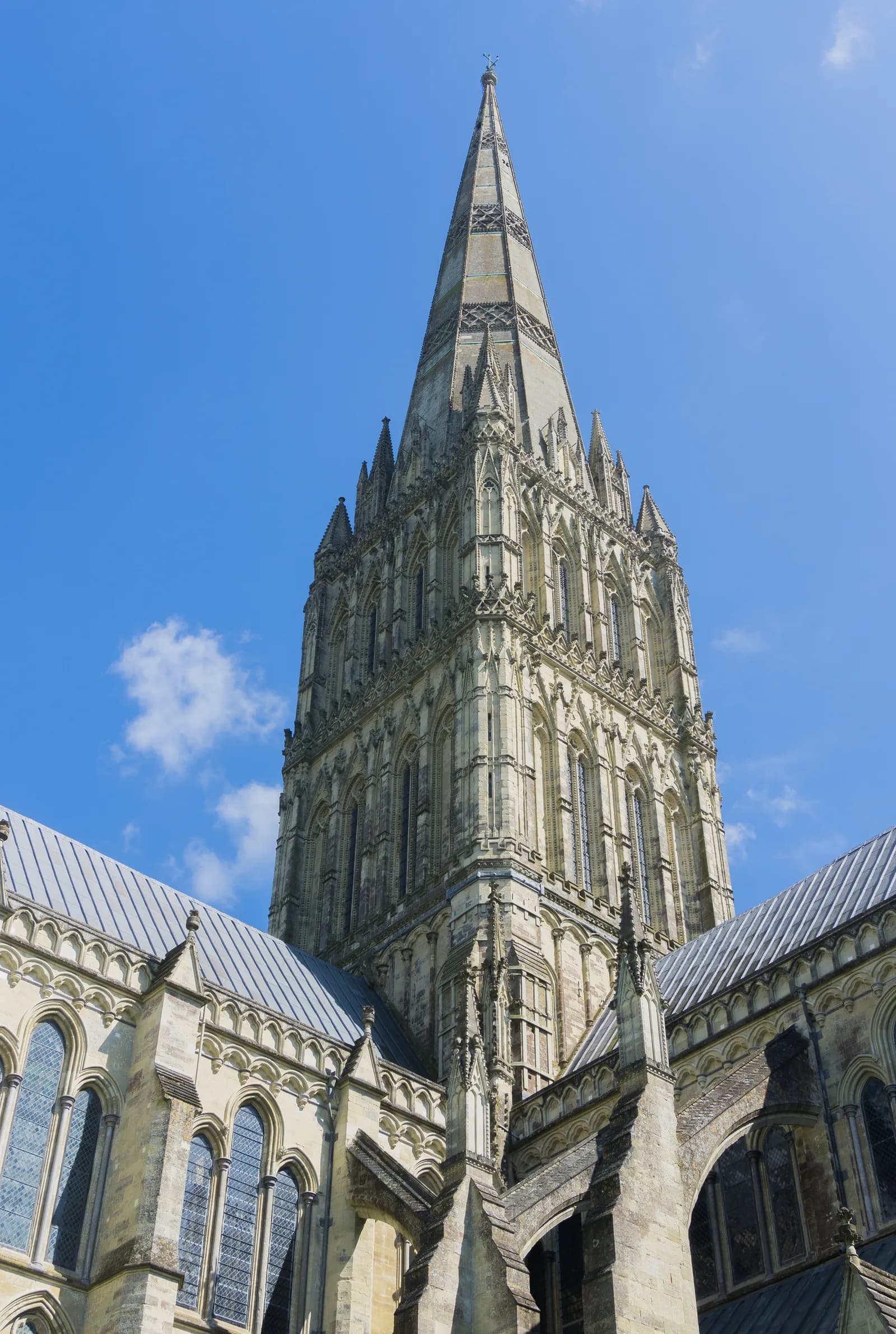
The spire rises 404 feet (123 metres) and is the tallest in England. When it was completed in 1330, it was initially the third highest in the country. It became the tallest after the spires at Lincoln Cathedral and Old St Paul's Cathedral collapsed during the sixteenth century. The structure remains a dominant landmark in the Salisbury skyline and a testament to medieval engineering.
Custodian of the Magna Carta
Salisbury Cathedral holds one of the four surviving original copies of the 1215 Magna Carta; the cathedral describes it as the best-preserved of the group. The document arrived in Salisbury through Elias of Dereham, who was present at Runnymede in 1215 and was tasked with distributing some of the original copies. He later became a canon of Salisbury and oversaw aspects of the cathedral's construction. William Longespée, 3rd Earl of Salisbury, who is named in the Magna Carta, also laid one of the cathedral's foundation stones. The charter, agreed by King John on 15 June 1215, limited monarchical power and established rights that have influenced constitutional law worldwide.
Inside the Building
The nave is tall and narrow, constructed from light grey Chilmark stone with dark polished Purbeck marble columns. It is arranged on three levels: a tall pointed arcade, an open gallery, and a small clerestory. The octagonal chapter house contains a slender central pillar and a decorative medieval frieze depicting scenes from Genesis and Exodus. The cathedral also houses a clock dating from around 1386, which is believed to be the oldest working modern clock in the world; it has no face and originally struck the hours on a bell.
The Cathedral Close and Modern Salisbury
Salisbury Cathedral possesses the largest cathedral close in Britain, a spacious enclosure that architectural historian Nikolaus Pevsner described as the most beautiful in England. The close contains numerous buildings of architectural and historical significance that contribute to the city's character. In 2021, during the COVID-19 pandemic, the cathedral served as a vaccination centre, with organ music played for those receiving vaccinations. Peregrine falcons have nested on the tower annually since 2013, adding a living natural history element to the ancient structure.