Standing barely three miles west of Salisbury Cathedral, Wilton House has been the seat of the Earls of Pembroke for more than four centuries. The estate's Palladian south front, world-famous state rooms, and sprawling parkland have made it one of England's most architecturally significant stately homes, while its 14,000-acre footprint continues to shape the local Wiltshire economy.
From Abbey to Aristocratic Seat
Wilton House occupies the site of a medieval Benedictine abbey that once dominated the area. Following the Dissolution of the Monasteries, Henry VIII presented the Wilton Abbey estates to William Herbert in March or April 1542. Herbert, a Welsh courtier who had married Anne Parr, sister of Henry's sixth wife Catherine Parr, began construction of the first house between 1544 and 1563. He was created Earl of Pembroke in 1551 by Edward VI and served as an executor of Henry VIII's will, establishing a family line that has held the title for over 400 years.
Of this original Tudor mansion, only the great tower at the centre of the east facade survives, distinguished by its three floors of oriel windows. The rest of the house was gradually transformed by successive earls into the classical palace that visitors see today.
Inigo Jones and the Palladian Transformation
The decisive architectural shift came in the 1630s under Philip Herbert, 4th Earl of Pembroke. With the encouragement of Charles I, he pulled down the southern wing and commissioned new state rooms in the Palladian style. The south front was executed by the French architect Isaac de Caus, who produced a design described as "quintessentially English" Palladian architecture; it features a central Venetian window, a balustraded roofline, and Italianate pavilion towers at each end.
A catastrophic fire in 1647 damaged the south wing, but it also provided an opportunity for refinement. Inigo Jones returned to Wilton with his assistant John Webb, and together they redesigned the interiors of seven state rooms. Jones's influence on the house secured its place in architectural history as one of the earliest and finest expressions of Palladianism in England.
The Double Cube Room and State Apartments
The highlight of the south front is the Double Cube Room, completed around 1653. Measuring 60 feet long, 30 feet wide, and 30 feet high, the space was designed by Inigo Jones and John Webb. Its pine walls are painted white with gold-leaf swags, and the coffered ceiling by Thomas de Critz depicts scenes from the story of Perseus. The room houses Anthony van Dyck's great paintings of the family of Charles I, alongside Chippendale mirrors and William Kent console tables.
Next door, the Single Cube Room is a perfect 30-foot cube and is thought to be the only room to have survived the 1647 fire intact. It retains its white pine panelling and an Inigo Jones-designed white marble chimneypiece. The painted ceiling by Cavalier D'Arpino shows Daedalus and Icarus, and the walls are hung with works by Peter Lely and Van Dyck. Other rooms of note include the Great Anteroom, which contains a Rembrandt portrait of the 4th Earl's mother; the Colonnade Room, furnished with William Kent pieces and Reynolds paintings; and the Hunting Room, adorned with carved panels by Edward Pierce dating from around 1653.
Literary Circles and Royal Visitors
Wilton House has played host to writers, actors, and monarchs since the Tudor period. In December 1603, James I, Anne of Denmark, and Prince Henry stayed at Wilton to escape the plague in London. Shakespeare's company, the King's Men, performed "As You Like It" there on 2 December 1603 for a fee of £30.
Under Mary Sidney, Countess of Pembroke, Wilton became a "paradise for poets" in the 1590s. Her literary circle, sometimes called the Wilton Circle, included Edmund Spenser, Michael Drayton, and Samuel Daniel. Her son, William Herbert, 3rd Earl, has been speculated by some scholars to be the "Mr W.H." to whom Shakespeare's sonnets are addressed. The First Folio of Shakespeare's plays was dedicated to the 3rd and 4th Earls as an "incomparable pair of brethren."
Charles I visited annually during the 1630s for hunting, and Queen Henrietta Maria was a frequent guest. The 4th Earl was an important patron of Van Dyck and amassed a collection that remains in the house today.
A Living Estate on Salisbury's Western Edge
Wilton House is not a museum frozen in time. The 18th Earl of Pembroke, born in 1978, and his family occupy roughly one-third of the house as a private residence. The estate encompasses 14,000 acres, including fourteen farms and more than 200 residential properties, and it employed around 140 people as of 2006.
The estate's influence extends into Salisbury itself. Salisbury Racecourse, which lies three miles southwest of the city on Wilton land, has hosted flat racing since the mid-16th century and holds fifteen race meetings each year between early May and mid-October. Notable winners have included the legendary Eclipse in 1769, Mill Reef in 1970, and Brigadier Gerard in 1970. Lester Piggott made his first ride there in 1948, aged twelve, and Winston Churchill raced his horse Colonist II at the course in 1949. The South Wilts Golf Course also sits on estate land.
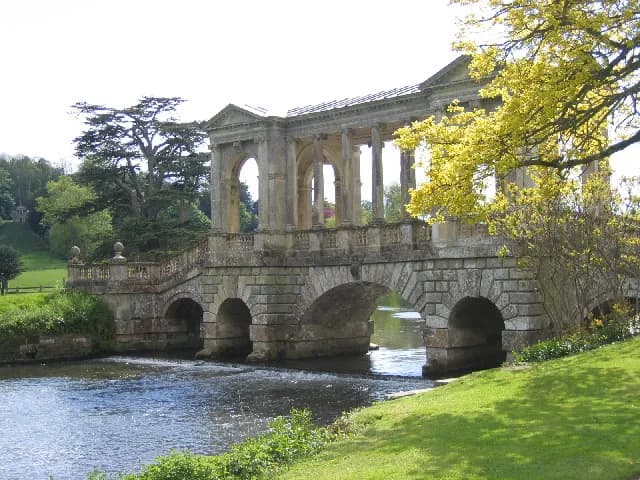
The Grade I listed Palladian Bridge, built over the River Nadder in 1736 and 1737 to designs by the 9th Earl and architect Roger Morris, is one of the estate's most recognisable landmarks. Its design was so admired that copies were erected at Stowe, Prior Park, Hagley, and Amesbury Abbey, and Empress Catherine the Great commissioned a version for Tsarskoye Selo near Saint Petersburg. The house itself was Grade I listed in 1951, and the park and gardens received the same designation in 1987.
The house and gardens have been open to the public since 1951, though typically only during the summer months. Visitors from Salisbury and beyond continue to be drawn by the combination of architectural splendour, historic art collections, and the enduring presence of a family that has shaped this corner of Wiltshire since the reign of Henry VIII.
What Is Confirmed and What Is Unclear
The historical architecture, art collection, and genealogical details are well documented in listed-building records and peerage histories. Current opening times, ticket prices, and any 2025 or 2026 exhibitions could not be verified from accessible sources; readers should consult Wilton House directly before planning a visit.